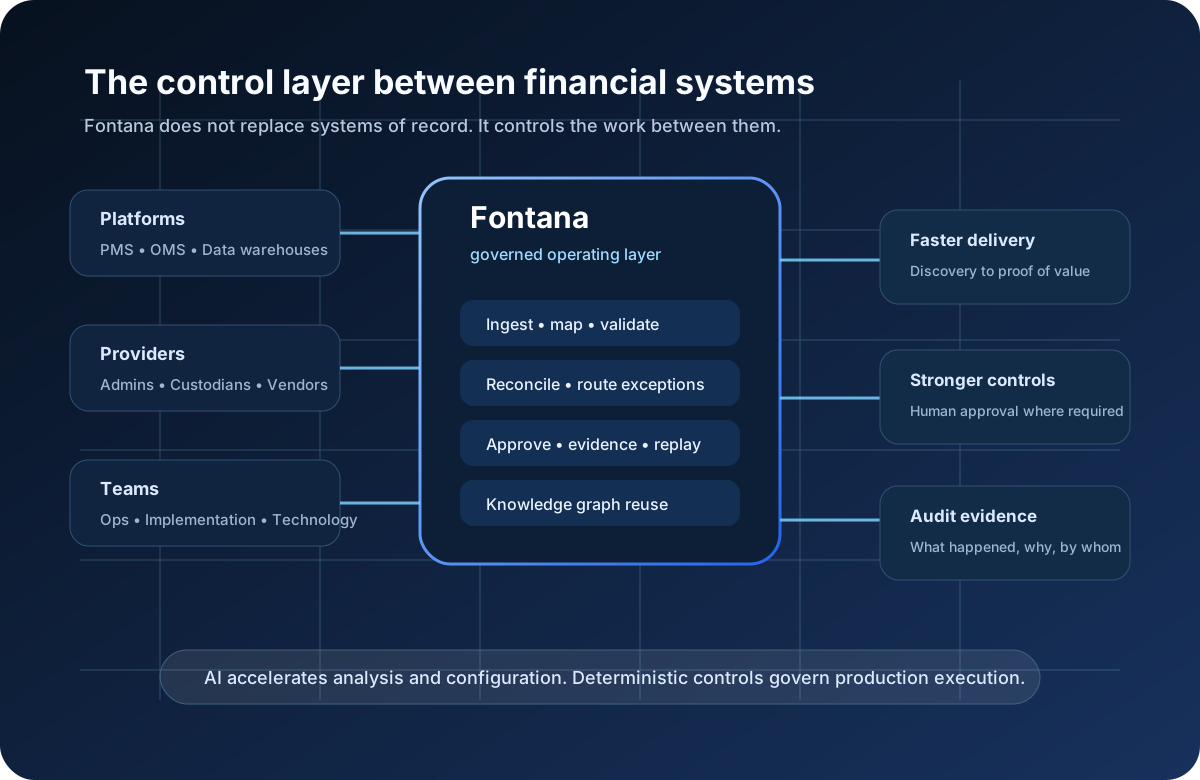
Major platforms are in place. The operational seams are still manual.
Financial-services firms have invested heavily in platforms, data warehouses, workflow tools and outsourcing partners. The work between those systems often still relies on files, spreadsheets, email, manual checks and undocumented process knowledge.
Onboarding, migration, file ingestion, validation, reconciliation, exceptions, approvals and evidence production.
Manual handoffs slow delivery, create operational risk, weaken lineage and make it difficult to evidence decisions.
Control and automate the work between systems without replacing systems of record.
Start with the workflow. Then automate what can be controlled.
Fontana starts with discovery: operational pain, systems involved, data flows, control points, manual steps and evidence requirements.
1. Understand the work
Map the workflow, systems, providers, files, controls, handoffs and approval points.
2. Find the leverage
Ingest data, map fields, validate completeness, reconcile outputs, route exceptions and generate evidence packs.
3. Capture knowledge
Rules, mappings, approvals and control logic become reusable workflows in the knowledge graph rather than hidden assumptions.
Outcome: faster operations with control, evidence and accountability preserved.
Discuss a workflowAI accelerates the analysis. Governance controls the execution.
Fontana is AI agnostic and can be AI-less where no AI is required. Production execution remains governed, controlled and auditable.
Assist
Governed agents can assist with data profiling, mapping analysis, rule discovery, document interpretation, exception explanation and workflow configuration.
Choose
Use Fontana’s agents, bring your own, build your own or buy specialist agents. The control framework remains consistent.
Control
Scoped permissions, approval policies, confidence thresholds, human review, audit trails and deterministic execution keep low-certainty decisions with human experts.
Flexible delivery depending on the client’s operating model and risk appetite.
Fontana can support discovery, managed outcomes, co-managed delivery or client-operated workflows.
Discovery and assessment
Reviews a defined operational workflow, data flow or onboarding process to identify bottlenecks, manual controls, data issues, reconciliation gaps and automation opportunities. Outputs can include workflow maps, lineage analysis, pain-point assessment, automation candidates, control gaps and a recommended roadmap.
Managed outcome
Fontana takes responsibility for a defined outcome, such as onboarding data analysis, migration validation, reconciliation setup, exception triage or evidence production.
Co-managed or client-operated
Fontana works alongside operations, implementation or technology teams while the client retains operational ownership and approval, or the client uses Fontana as an internal control layer.
Not another black box. A governed operating layer.
Most automation projects solve one slice: data movement, tickets, reconciliation, document processing or outsourced capacity. Fontana brings the pieces together.
- Financial-services domain knowledge.
- Governed AI agents.
- Deterministic workflow execution.
- Human approval where required.
- Full audit trail and evidence capture.
- Reusable rules, mappings and operational knowledge.
- Flexible deployment models.
- No replacement of systems of record.
Relevant wherever manual, data-heavy work crosses systems, teams or providers.
Common places Fontana can prove value quickly.
- Client onboarding onto investment platforms.
- Fund onboarding and data migration.
- Legacy system migration and data validation.
- Provider file ingestion.
- Mapping between client formats and target platform formats.
- Pre-load and post-load reconciliations.
- NAV, valuation and position checks.
- Exception management and evidence packs.
- Operational workflow documentation and control capture.
- Data lineage, approval and audit evidence.
Focused discovery, fast proof of value, repeatable control.
The purpose is to understand the client’s actual pain before recommending a solution or deployment model.